Thursday, March 24, 2016

The Mekong River, Vietnam – Saigon Day 2 – March 23rd

Joani and I took a tour bus about an hour and a half away from Saigon (which is on the Saigon River) to the mighty Mekong, to a point about 15 km upstream from its delta. It’s quite muddy from all the silt that washes off the fields, rice paddies and jungles on its 4800 km journey to the South China Sea.

On the way we stopped at a Buddhist temple (seems to be obligatory on every tour now). We saw yet another reclining Buddha, depicting him a state of total relaxation and bliss upon achieving Nirvana.

River boats on the Mekong in Vietnam all have eyes painted on the front, as if they were crocodiles. Tradition or superstition has it that this brings good luck, or keeps actual crocodiles away, or something like that.

The river here is spanned here by an 8 km suspension bridge that was completed 8 years ago.

We crossed the river in a typical river boat to visit a farm on a 12 km long island.


After seeing bee hives, we had honey and pollen tea that was out of this world (and I normally don’t like tea). They poured hot green tea over a mixture of honey and pollen with just a touch of kumquat.

They of course sold locally produced pollen

Here is Joani with a kumquat, which flavors tea similar to the way lemon does

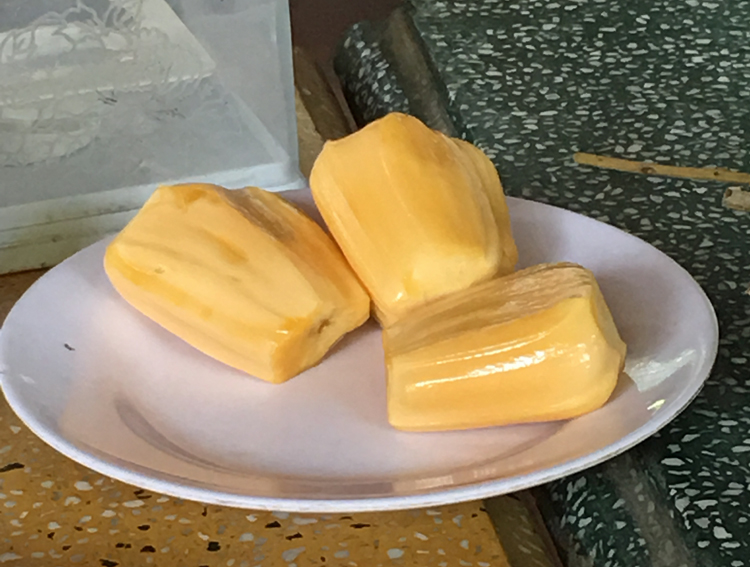
Then we had a snack of locally grown fruit: mango, pineapple, jack fruit, longan (a litchi-like fruit), and dragon fruit. My favorite was the jack fruit (below), which was very sweet and somehow tasted like banana crème pie.

Then we took a sampan ride through narrow waterways lined with cocoa trees:


Finally, an excellent Vietnamese lunch of river fish, pork and rice, rice-paper eggrolls, river shrimp, sticky rice, and a vegetable-and-rice-noodle soup.


Then back across the Mekong on our river boat and onto the bus and back to our floating hotel. The most impressive building of the Saigon skyline was this new and modern 68 story office and condo spire. A major tenant is Ernst & Young (EY).

Tonight we set sail for Hanoi. It’s more than 1000 km to the north, so we have a day at sea on the way. This is good, as Joani is still sorting her Angkor Wat pictures. So much to do, so little time.

Wednesday, March 23, 2016

Good Morning, Vietnam! - Saigon Day 1 - March 22nd

Saigon was renamed Ho Chi Minh City in 1976, but our guide said most people still call it Saigon, its name for the previous 350 years. Confirmed by the name of the most popular local beer:


Saigon is the city of motor bikes: 9 million people and 4 million bikes.

I took a “Good Morning Vietnam” tour, focused on places related to the War. Trigger Alert (not a joke): It can be disturbing.

Above is the Rex Hotel, where many GIs picked up girls in the “American Bar” on the upper floors. Below is the former Presidential Palace, renamed the “Reunification Palace” in 1976:


Here is the tank that knocked down the gates of the Presidential Palace in 1975 and is now a national monument. President Thiệu had already left; he died in California in 1998.

Here is the F-4 whose South Vietnamese pilot strafed and bombed Thieu’s palace late in the war before flying north and defecting. Turned out he had been a spy for the North all along. He is a national hero. The plane is now also a monument on the grounds.


Here is the current American Consulate, built on the site of the former US Embassy, where the iconic “last helicopter out” photo was taken. That structure no longer exists. The current US Embassy is in Hanoi. Relations were normalized between the two countries in 1996. People waiting in line are applying for visas,

We visited the War Remnants Museum, which chronicles the “American War” as it is called here. Much US war material is on display. This can be disturbing to visit, as the museum highlights the millions of Vietnamese who were, killed, maimed and born with birth defects. It focuses on events like like My Lai and the "heavy US use of chemical weapons:" over 75 million liters of Agent Orange and other defoliants that included over 60,000 pounds of dioxin. Dioxin remains active in the soil and water in many places; and was found in mother's breast milk during and after the war.

Below, a B-52 Seismic Bomb:

Seismic bombs were used to attack VC underground networks, and we visited the tunnels of Củ Chi, an immense 200 km network of multi-level connecting tunnels about 45 km west of Saigon along Highway 22, the main supply route from Cambodia. The Viet Cong used this complex to launce the 1968 Tet Offensive. As many as 16,000 hid underground here at any given time.
The entrances were small and well concealed. I was able to fit, but barely, after watching a guide demonstrate:

Underground conditions were miserable – everyone had intestinal parasites, 50% malaria, and poisonous snake and insect bites were common. But the multi-layered nests were extremely effective in hiding the Viet Cong, who on occasion dug 5 km tunnels to get beneath the big US camp at Củ Chi and attacked the GIs inside their own base.

There is a firing range at the Củ Chi complex where for $20 you can fire a banana clip of live ammo from an AK-47 (or an M-16):

At the Củ Chi Site, which is a national monument, there are examples of the “tiger traps’ deployed in the jungle against the GIs.

Here is a tableau of how the VC constructed improvised delay mines to destroy US Tanks using recycled ordnance.

One last shot of a tunnel entrance:


All in all, a very sobering day. Our tour guide was from My Lai. He and his family were not in the village when the massacre occurred. They had gone to visit relatives in a neighboring village and stayed overnight. However, since the war ended, five of his relatives have died of cancer.


Tomorrow: a river trip on the Mekong. Then a day at sea where Joani should have time to sort her Angkor Wat photos.

Monday, March 21, 2016

Ream National Park, Cambodia - March 20th

After the hustle and and crowds of Bangkok, population 14 million, the Cambodian port of Sihanoukville, population 89,000, was a nice change of pace. Sihanoukville is known for its port, its beaches, and the mangrove jungles and rivers of Ream National Park. We meandered upriver through the park in long boats, docked, and walked about 3 kilometers to a beach with a little Tiki-bar.


At the dock we could see jellyfish suspended just an inch or two below the surface of the water:


This water buffalo belongs to one of the 100 or so families that live on farms inside the Park, grand-fathered when it was created. Like everyone else, they are poor. Cambodia was ravaged and has not recovered from the Pol Pot Khmer Rouge regime and the genocide and civil war that killed 2 million. It wiped out an entire generation.

Our guide, Dara, said he was born in 1975 and had to join one of the factions when he was fifteen. Shown how to fire an AK-47, he fought in the jungles for four years before the war ended.

He said life expectancy in Cambodia remains below 60 years due to a variety of issues including high infant mortality, water-borne parasites, malnutrition, and a lack of medical care. Affluent people go to Thailand or Vietnam for medical care.


Took a swim at the beach but didn’t really cool off because the water temperature was in the 90s; the sun was cooking the water between the beach and a sand bar. Did cool off with a local beer at the Tiki Bar.


It seems the most popular local beers are branded with name of the most famous local landmarks: Kilimanjaro Beer in Tanzania and Angkor Beer in Cambodia.


Joani emailed that she arrived in Siem Reap with no problems; that they are staying in a great hotel; that they were entertained with a fantastic cultural show during dinner, and she is looking forward to Angkor Wat tomorrow.


p.s. Forgot to give credit to our great tour guide in Bangkok, Pudtipong Nawasornyuttana (he goes by “Jean”). Here he is saying good bye to us and Drew and Tanya at the cruise terminal after great Saturday afternoon shopping at Bangkok’s famous Weekend Market. Tanya bought a beautiful 9-inch porcelain soup tureen that she had seen at the restaurant Friday night; Jean knew exactly in which of the 30,000 stalls to find it.


Above, at the Issaya Siamese Club for dinner Friday night. When we opened the menu, Tanya said, “I know the chef!” Turns out Ian Kittichai has appeared on a TV cooking show and is in fact Thailand’s “Iron Chef” on that show. The meal was great.

Sunday, March 20, 2016

Bangkok Day 2 - March 19th

The Royal Palace

The Golden Stupa is a major shrine of the Royal Temple inside the Royal Palace grounds and is said to contain ashes of the Buddha. The surface is covered by two million one-inch diamond-shaped tiles, each gilded with a dollar’s worth of gold. Yep, $2 million total.

Below is a section of hand painted wall mural; one of 178 that encircle the Palace grounds under covered archways. Thai kings take the name Rama claiming immortality as descendants of the Hindu God Rama, seventh avatar of Vishnu. The panels recount the Ramayana, the events of Rama’s 
incarnation, life, and struggles.


Yes,Thailand is Theravada Buddhist (93.6%). Hinduism and Buddhism are much more ecumenical than Christianity.

For 150 years the Royal Palace was the royal residence of the King. 100 years ago, the Royal Family moved to a new residence because this 60 acre complex was not big enough for the King, his 100 wives, and his more than 3000 children. Yes, this was basis for the Yul Brenner hit movie and the Broadway show, “The King and I.”


Below is the Royal Reception Hall, still used today for official functions. There is a reception area for women on the left and for men on the right; they may not be co-mingled. The grand dining room sits 2000.


Below is the alter of temple of the Emerald Buddha inside the Palace Grounds Temple, the most sacred temple in Thai Buddhism. The picture was taken with a telephoto lens from outside the temple; no cameras are allowed inside. Little known fact: the Emerald Buddha is actually made of Jade.


The Emerald Buddha wears three different sets solid-gold vestments, depending on the religious calendar. Only the King himself may undress and dress the Emerald Buddha. Images of the three outfits below are from a postcard:


Wat Arun - the Temple of Dawn


We took a long boat across Bangkok’s main river to see the Temple of Dawn, Wat Arun. This view of the temple is one of the most iconic shots of Bangkok, or at least it is when the main Stupa is not obscured by scaffolding for refurbishment:


Like the other major Temples, Wat Arun has an Ordination Room for the induction into the Temple Order of monks who have completed their training. This temple inside the temple is open for worship and is the most sacred place in the temple complex. We could go inside and take pictures if we removed our hats and shoes and had on long pants or long skirts and acted respectfully:


Here behind Joani you can see the beautiful inlay work on one of the minor stupas of Wat Arun


Finally, here is the modern Bangkok downtown skyline as seen from the river:


Joani flies to Siem Reap tomorrow with an Oceania overland tour to Angkor Wat; while Bob will be seeing Sihanoukville where the ship is docking. We will meet back up in two days in Saigon.


Saturday, March 19, 2016

Bangkok - March 18th

Ever since watching the James Bond long boat chase scene in “The Man with the Golden Gun” (link here), we have wanted to come to Bangkok and ride those boats. The local waterways are very much just like the movie, though we didn’t go nearly as fast as 007 (they wouldn’t let Joani drive). Here is our long boat coming to pick us up:

And here we are starting our ride:

And here is another boat passing us going the other way:

In Bangkok a modern citys rises next to quiet canal communities and alleys crammed with shops, houses and markets. And an opulent Royal Palace and many ornate temples displaying gold figures of Buddha.


One great stop was the Giant Golden Reclining Buddha at the temple of Wat Pho:
The head of the giant reclining golden Buddha. The Reclining Buddha is 150 feet long. It was made of brick, then plastered, then gilded with real gold.

The temple was built by King Rama I the Great who in 1782 established Bangkok as capital of the Chakri Dynasty. Some of his ashes are kept here. The current king, Rama IX, ascended the throne in 1946 and is the world's longest-serving head of state. 

Here is Joani at the mid-point of the giant golden reclining Buddha

This temple complex features over 1,000 Buddhas; here are a couple:


Khao San Road


No trip to Bangkok is complete without visiting Khao San Road, which bustles and rocks until 2:00 or 3:00 AM. Yes, the scorpions in the green plastic tub below are being sold as a snack to eat. Very popular with the male 20-something back-packers who come here from all over the world:
But Khao San Road is not the red light district of Bangkok. That would be Soi Cowboy. In the clubs there it’s hard to distinguish the girls from the lady boys and you can do or buy anything you could possibly think of; as well as many that you couldn’t even imagine. We did not go there.

Tomorrow: a second post from Bangkok featuring the Royal Palace, the Emerald Buddha, and the Temple of Dawn at Wat Arun.